

The Lawyer You Meet Is Rarely the One Who Handles Your Case
There’s a moment I’ve witnessed hundreds of times. Someone walks into a personal injury law firm—maybe three days after a car accident, maybe a week after a bad fall at work—and they sit across from a polished, confident attorney who listens carefully, nods at the right moments, and says something like, “We’re going to take care of you.” The client leaves feeling genuinely relieved. They signed. They trusted. They went home and told their spouse they finally found someone in their corner.
Then six weeks pass.
The attorney they met is nowhere to be found. Their calls go to a paralegal. Their questions get answered—sometimes—by a case manager they were never introduced to. And the slow, creeping dread sets in: Was that first meeting just a sales pitch?
I’ve spent 15 years on the intake and strategy side of personal injury law, and I can tell you honestly: that scenario isn’t rare. It’s the norm at volume-driven firms. What I want to do here is walk you through what actually happens after you sign, what each person on a legal team is supposed to do, and—most importantly—what questions to ask before you ever pick up a pen.
What the First Meeting Is Really Telling You
Before you walk into that consultation, understand what it is and what it isn’t. It’s an evaluation—the firm is deciding whether your case has enough value to take on contingency. You’re also evaluating them, though most injured people don’t realize they have that power.
The attorney you meet at intake may be the firm’s best communicator, their most senior partner, or their designated “closer.” That doesn’t mean they’ll touch your file again. At a reputable personal injury law firm boston, the attorney who meets you should be able to tell you directly who will manage your case day-to-day, what their role will be, and when you can expect to hear from them. If that conversation doesn’t happen, ask for it.
The before-and-after is stark:
- Clients who ask questions upfront tend to have clearer expectations, fewer surprises, and better outcomes because they stay engaged.
- Clients who don’t ask often feel abandoned by month three, stop returning calls, and lose track of deadlines that matter.
That difference—between informed and uninformed clients—isn’t about intelligence. It’s about knowing what to look for before you sign.
What Actually Happens After You Sign
Most clients imagine their attorney is working on their case from day one. The reality is more layered than that—and knowing the actual sequence removes a lot of unnecessary anxiety.
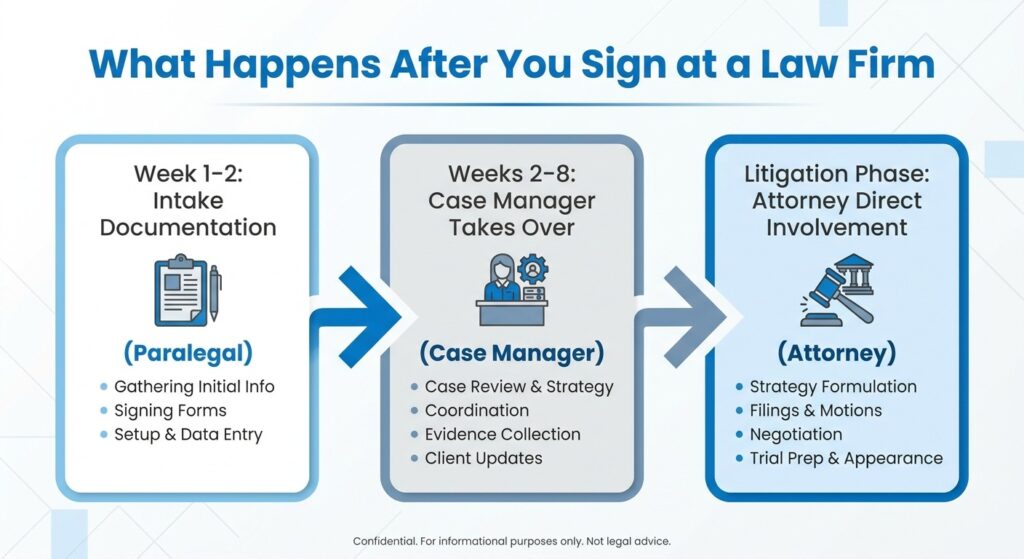
Week 1–2: Intake Documentation A paralegal or intake coordinator gathers your medical records, accident reports, insurance information, and employment records. This is foundational work, and paralegals are trained to do it well. The problem isn’t that the attorney isn’t doing this—it’s when no one tells you this is happening or why.
Weeks 2–8: Case Manager Takes Over A case manager typically becomes your primary contact. They track your medical treatment, follow up with providers, and begin building the demand package that will go to the insurance company. Think of them as the operational center of your case. A good case manager is worth their weight in gold. A stretched-thin one is where cases start to slip — and the numbers aren’t hypothetical. Industry data shows that firms with strong client relationships average around 30 cases per person, while high-volume operations using automation report managing up to 50 cases per staff member per month. At the far end, job postings at volume personal injury firms routinely list caseloads of 115 to 135 active files per case manager as a standard expectation.
The Attorney’s Role During This Phase Here’s what surprises most clients: the attorney is largely in the background during early case development—reviewing strategy, advising on liability, handling motions if litigation has started. Most personal injury cases resolve through settlement, which means the attorney’s most visible work often happens in a compressed window near the end. That’s legitimate. What’s not legitimate is when the attorney is reviewing your file for the first time the week before a settlement conference.
If Your Case Enters Litigation Everything changes. Timelines stretch—sometimes into years. Depositions, discovery, expert witnesses, motions—these require attorney-level attention and attorney-level communication. If you’re in litigation and haven’t spoken to your actual lawyer in months, that’s a warning sign worth acting on immediately.
Understanding the Team: Who Does What
Let’s be direct about roles, because this is where most clients get confused.
| Role | Primary Responsibility | When You’ll Hear From Them |
|---|---|---|
| Attorney | Legal strategy, settlement negotiation, court representation | Key decision points, litigation phases |
| Paralegal | Documentation, filings, records gathering, deadline tracking | Early intake, procedural updates |
| Case Manager | Day-to-day coordination, treatment tracking, client communication | Regularly throughout the case |
According to the NALA Code of Ethics and Professional Responsibility, a paralegal may perform any task properly delegated and supervised by an attorney — as long as the attorney remains ultimately responsible to the client and maintains a direct relationship with the client. That last clause matters: if the attorney has effectively handed off your file and lost that direct relationship, it’s worth asking whether the arrangement actually meets that standard.
The contingency fee structure shapes all of this in ways clients rarely think about. When a firm takes your case on contingency—meaning they only get paid if you recover—they’re making a business calculation. Typically, personal injury attorneys take 33% of a settlement, or a higher percentage if the case goes to verdict. That fee structure aligns incentives in your favor in one sense: the firm wants to win. But it also creates pressure to settle quickly and move volume.
A firm with 400 active cases has different incentives than one with 80. Ask how many cases the attorney personally manages. The answer will tell you a lot.
Volume Pipeline vs. Advocacy Model
This is the comparison that matters most when you’re choosing where to sign.
Volume Pipeline Firm Built around intake efficiency. Heavy advertising, high case volume, tiered staff model where attorneys are largely reserved for settlement negotiations and court appearances. Communication is systematized—automated updates, templated letters, callbacks from whoever is available. For straightforward cases with clear liability and documented injuries, these firms can achieve reasonable settlements. But if your case is complex, disputed, or requires genuine legal creativity, you may find yourself underserved.
Advocacy Model Firm Built differently. The attorney is involved earlier and more consistently. Staffing ratios are lower. Case managers and paralegals work closely with the attorney rather than independently of them. Communication is more direct and more personal. These firms tend to be smaller and more selective—precisely because they’re investing more time per file.
A note on reviews and referrals: They’re useful, but read them critically. Look for reviews that describe specific experiences—”My attorney called me personally when the offer came in”—rather than generic praise. Someone who can tell you what happened six months after signing is more valuable than someone who loved the first meeting.
The Questions That Actually Matter
This is the part I wish someone had handed to every client I’ve ever seen walk through an intake door. Before you sign anything, ask these—and pay close attention to how they’re received, not just what’s said.
On attorney involvement:
- Will you personally handle my case, or will it be assigned to another attorney or case manager?
- Who will negotiate my settlement—you, or a senior paralegal?
- What happens to my case if you leave the firm?
On communication:
- How often will I receive updates, and from whom?
- What’s the best way to reach someone when I have a question?
On the case itself:
- How does your firm handle cases that go into litigation versus those that settle early?
- How many active cases do you personally manage right now?
On fees:
- What is the contingency fee percentage, and does it change if the case goes to trial?
A firm that’s transparent about its staffing structure is a firm that respects your ability to make an informed decision. A firm that gets vague or defensive when you ask is showing you something important.
One Step Before You Decide
Before you sign with any personal injury law firm, ask for a brief follow-up call—not another full meeting, just fifteen minutes—with the specific attorney or case manager who will own your file day-to-day.
If the firm won’t arrange that, you have your answer.
If they will, use it. Introduce yourself, ask your questions, and pay attention to whether they already know your name and your situation. That small test will tell you more about how your case will be handled than any billboard, any rating, or any reassuring first impression ever could.
Trust the feeling in the room. Not the polish. Not the awards on the wall. The feeling you get when you ask a hard question and watch how it’s received.