
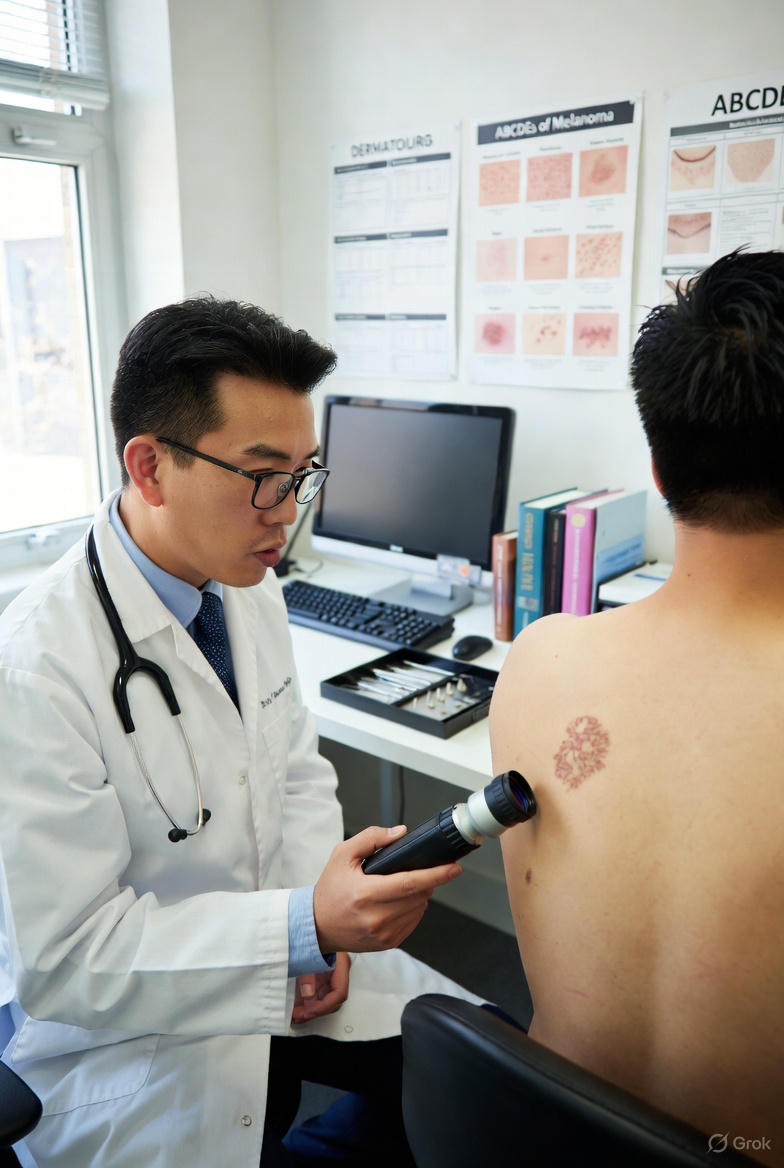
A new or changing mole on your skin can cause immediate and significant anxiety. We are taught to be vigilant, to watch for the “ABCDEs” of melanoma, and to see a dermatologist for any spot that seems unusual. We place immense trust in these specialists to identify a dangerous lesion and take appropriate action. But what happens when that trust is broken? What if your doctor dismisses a deadly melanoma as a harmless mole? The consequences can be devastating.
Patients who suffer from such an error often don’t know where to turn; they might even be hesitant to search for a medical malpractice attorney Brooklyn, feeling unsure if a mistake was even made. Understanding the difference between a benign skin condition and a malignant one is the first step. The second is understanding when a doctor’s error crosses the line from an honest mistake to medical negligence.
The Anxiety of a Skin Spot: Why We Trust Dermatologists
The skin is our body’s largest organ, and it’s the only one we can see. When a spot appears, changes, or refuses to heal, it is a visible, constant source of worry. We turn to dermatologists because they have specialized training and tools, like dermatoscopes, to see what our untrained eyes cannot. We rely on their “clinical judgment” to distinguish a harmless spot from a potentially fatal one.
This trust forms the basis of the doctor-patient relationship. We expect a physician to listen to our concerns—especially when we report that a lesion is new, growing, itching, or bleeding. When this trust is violated by a dismissive attitude or a failure to perform a basic test, the patient is the one who pays the price.
Not Every Misdiagnosis is Malpractice: The Legal Line
It is a critical distinction: not every misdiagnosis is medical malpractice. Medicine is a complex practice, not a perfect science. Some skin conditions can be incredibly difficult to tell apart, even for a trained specialist. An “honest mistake” is a judgment that a reasonably competent doctor might have made under the same circumstances.
Medical negligence, or malpractice, occurs when a doctor’s care deviates from the accepted “standard of care,” and that deviation directly causes harm.
Understanding the “Standard of Care” in Dermatology
The “standard of care” is the legal yardstick used to measure a doctor’s actions. It is not a standard of perfection. The law asks: What would a reasonably prudent and competent dermatologist have done in this specific situation?
- Meeting the Standard: A doctor examines a mole, finds it atypical, biopsies it, and the pathology report comes back as benign. The doctor has met the standard of care.
- Breaching the Standard: A patient points to a dark, irregularly-bordered mole that has been growing for six months. The doctor glances at it from across the room, says, “That’s nothing to worry about,” and fails to examine it or offer a biopsy. This is a likely breach of the standard of care.
The Four Elements of a Malpractice Claim
To successfully prove a diagnostic malpractice case, your attorney must establish four key elements:
- Duty: A formal doctor-patient relationship existed, meaning the doctor owed you a duty of competent care.
- Breach: The doctor breached that duty by failing to meet the standard of care.
- Causation: This specific breach (e.g., the failure to biopsy) was the direct cause of your injury (e.g., the cancer metastasized).
- Damages: You suffered significant, demonstrable harm as a result, such as the need for more invasive surgery, a reduced life expectancy, or financial loss.
The Three Main Types of Skin Cancer
To understand what can be mistaken for skin cancer, it helps to first know what the “enemy” looks like. There are three primary types.
Basal Cell Carcinoma (BCC)
This is the most common type of skin cancer. It often appears as a small, “pearly” or waxy bump, or a flat, flesh-colored patch. BCCs grow slowly and very rarely spread to other parts of the body. However, if left untreated, they can be locally destructive, growing deep into the skin, tissue, and even bone.
Squamous Cell Carcinoma (SCC)
This is the second most common type. It often looks like a firm, red nodule, a scaly flat patch, or a sore that heals and then re-opens. SCCs are more likely to spread than BCCs, although the risk is still relatively low.
Melanoma: The Most Dangerous
Melanoma is the most aggressive and dangerous form of skin cancer. It forms in the melanocytes, the cells that produce pigment. It can develop from an existing mole or appear as a new dark spot. We use the ABCDE acronym to spot it:
- Asymmetry: One half does not match the other.
- Border: The borders are irregular, scalloped, or poorly defined.
- Color: The color is not uniform, with shades of brown, black, tan, red, white, or blue.
- Diameter: The spot is larger than 6mm (the size of a pencil eraser).
- Evolving: The mole is changing in size, shape, color, or is a new symptom like bleeding or itching.
A diagnostic error involving melanoma is the most catastrophic, as a delay in diagnosis can be fatal.
Benign Imposters: Common Skin Conditions Mistaken for Skin Cancer
This is where clinical judgment becomes so critical. Many harmless, benign skin conditions are fantastic mimics of cancer.
Seborrheic Keratosis: The “Warty” Lookalike
These are extremely common, non-cancerous skin growths that often appear in middle age. They can be tan, brown, or black and have a waxy, scaly, or “stuck-on” appearance, like a dab of candle wax.
- How it mimics cancer: A dark, irritated, or rapidly growing seborrheic keratosis can look identical to a melanoma.
- When it’s negligence: While a doctor can often diagnose these by sight, an inflamed, bleeding, or rapidly changing lesion that the patient is concerned about warrants a biopsy to be certain. Dismissing it without a close look is a risk.
Moles (Nevi): Benign vs. Atypical
This is the classic mix-up. A “common nevus,” or a normal mole, is usually a small, round, evenly colored brown spot. An “atypical nevus” (or dysplastic nevus) is a benign mole that is a melanoma mimic. It may be larger, have irregular borders, and have multiple shades of color.
- How it mimics cancer: An atypical mole can look exactly like an early-stage melanoma. There is no way to be 100% certain without a biopsy and pathology.
- When it’s negligence: The standard of care for a new or changing atypical mole is to biopsy it. A doctor who decides to just “watch” a lesion that is actively evolving by the patient’s report is taking a dangerous gamble with the patient’s life.
Actinic Keratosis: The Pre-Cancerous Imposter
Actinic Keratosis (AK) is not benign, but it is not yet cancer. It is a pre-cancerous lesion caused by sun damage, appearing as a rough, scaly, “sandpaper-like” patch.
- How it mimics cancer: An AK is a direct precursor to Squamous Cell Carcinoma (SCC). A thicker, more tender, or inflamed AK may have already converted to an SCC.
- When it’s negligence: The standard treatment for AKs is often cryotherapy (freezing). However, if a lesion is particularly thick, large, or fails to respond to freezing, the standard of care requires a biopsy to ensure it hasn’t already become an invasive SCC.
Psoriasis and Eczema: The Inflammatory Mimics
These common inflammatory skin diseases cause red, scaly, and sometimes crusty patches that can be very itchy.
- How it mimics cancer: A single, persistent patch of psoriasis or eczema can be mistaken for SCC, which also presents as a scaly, red patch. In rarer cases, it can even mimic amelanotic melanoma (a melanoma with no pigment).
- When it’s negligence: A doctor should be able to diagnose psoriasis or eczema based on the patient’s history and the presence of patches elsewhere. But if a patient has a single, stubborn, non-healing “eczema” patch that doesn’t respond to any treatment, a biopsy is necessary to rule out cancer.
Dermatofibroma: The Firm Bump
A dermatofibroma is a common, harmless bump that is firm to the touch. It is essentially a small, hard scar under the skin, often forming after a minor trauma like an ingrown hair or insect bite. A key sign is the “dimple sign”—it puckers inward when pinched.
- How it mimics cancer: A dermatofibroma, especially a darker-colored one, can be mistaken for a nodular melanoma, a very aggressive type of melanoma that grows vertically into the skin.
- When it’s negligence: Failing to perform the dimple test or failing to biopsy a firm, raised nodule that does not have a clear history could be a breach of care.
Cherry Angiomas and Pyogenic Granulomas (Blood Vessel Growths)
Cherry angiomas are very common, small, red “dots” that are benign clusters of blood vessels. A pyogenic granuloma is also a benign blood vessel growth, but it grows very rapidly and bleeds extremely easily.
- How it mimics cancer: A bleeding pyogenic granuloma can mimic a bleeding basal cell carcinoma. A dark, thrombosed (clotted) angioma can look just like a black melanoma nodule.
- When it’s negligence: Any new, rapidly growing, bleeding lesion should be taken seriously. While often benign, a biopsy is the only way to confirm it isn’t an amelanotic melanoma or other skin cancer.
When Does a Dermatologist’s Mistake Become Negligence?
This is the bridge between a medical mistake and a legal claim. The error becomes negligence when the doctor’s actions are provably substandard.
Failure to Biopsy a Suspicious Lesion
This is the most common and most clear-cut form of dermatological malpractice. A patient presents with a lesion that has multiple “red flags”—it’s new, it’s changing, it’s asymmetric, it’s bleeding. The doctor’s failure to take a biopsy, instead offering false reassurance, is a textbook breach of the standard of care. A patient’s own report of change is one of the most important diagnostic clues, and ignoring it is a serious failure.
Misinterpreting Pathology Reports
Sometimes the dermatologist does their job right (performs a biopsy), but the error happens at the next stage. A dermatopathologist (a doctor who specializes in reading skin biopsies) may misread the slide. They might mistake an invasive melanoma for a benign atypical mole. In this scenario, the pathologist is the negligent party, and the dermatologist who relied on that report may be blameless.
Laboratory Errors and Mix-Ups
This is a systemic failure. The lab might mix up your biopsy sample with another patient’s. You, with a dangerous melanoma, are told your biopsy was benign. Meanwhile, another patient with a harmless mole is told they have cancer and undergoes an unnecessary and disfiguring surgery. This is clear negligence on the part of the lab and hospital system.
The Consequences of a Delayed Skin Cancer Diagnosis
When a doctor fails to diagnose skin cancer, the consequences are not minor. This delay is the “Causation” and “Damages” portion of a malpractice claim.
How a Delay Impacts Prognosis
The single most important factor in surviving melanoma is depth (known as “Breslow’s thickness”).
- Stage 1 (Thin) Melanoma: A melanoma caught early, when it is less than 1.0 mm thick, is treated with a simple outpatient excision. The 5-year survival rate is over 95%.
- Stage 4 (Metastatic) Melanoma: A melanoma that was missed for a year or more may have had time to spread (metastasize) to the lymph nodes, lungs, liver, or brain. The 5-year survival rate for distant-stage melanoma plummets to around 30%.
A doctor’s 12-month delay is not just a delay; it can be a death sentence.
The Need for More Invasive Treatment
A delayed diagnosis does not just impact survival; it drastically changes the patient’s life.
- Early Diagnosis: A simple, wide local excision in the doctor’s office.
- Delayed Diagnosis: This may require a sentinel lymph node biopsy (a surgical procedure to check if the cancer has spread), a full lymph node dissection, immunotherapy (like Keytruda or Opdivo, which have severe, life-altering side effects), targeted radiation, or chemotherapy.
The harm is the difference between a simple scar and a year of grueling, toxic treatments and a lifetime of “scanxiety” waiting for the cancer to return.
What to Do If You Suspect a Diagnostic Error
If your doctor dismissed a concern and you later found out you have skin cancer, or if you simply feel your concern is not being heard, you have options.
- Get a Second Opinion Immediately. Your health is the single most important priority. If your gut tells you a doctor is wrong, find another one. Do not wait.
- Trust Your Gut. You know your body better than anyone. If you see a spot that is changing, growing, or just “feels wrong,” insist on a biopsy. A competent doctor will respect your concern.
- Request Your Medical Records. You have a legal right to a copy of your full medical chart, including all pathology reports.
- Consult a Legal Professional. If you were harmed by a delayed diagnosis, speak to an attorney who specializes in medical malpractice. They can have your records reviewed by an independent medical expert to determine if the standard of care was breached.
Proving Your Case: The Role of Medical Experts
You cannot win a medical malpractice case on your own. Your attorney’s entire case will be built on the testimony of medical experts. An experienced attorney will retain a board-certified dermatologist and perhaps an oncologist to review your case. These experts will provide the official testimony needed to prove to a jury what the standard of care was, how your doctor violated it, and how that violation directly led to your devastating prognosis and harm.
Conclusion: The Path to Accountability and Healing
A spot on the skin is a small thing, but a diagnostic error can have massive, life-altering consequences. While many skin lesions are benign, a doctor’s failure to take a suspicious spot seriously is a profound breach of trust. A delayed diagnosis can mean the difference between a simple scar and a systemic, life-threatening illness. It can lead to disfiguring surgeries, grueling treatments, and permanent harm. If you or a loved one has suffered because a doctor dismissed a dangerous skin cancer as a harmless blemish, you have a right to seek answers and accountability. The path to justice often involves specialized legal and medical analysis to understand what went wrong and what should have been done. In cases where the resulting scar or disfigurement is severe, a patient may even need to consult a plastic surgery lawyer to understand the full scope of their future reconstructive needs. Ultimately, holding negligence accountable is not just about compensation; it’s about getting justice and ensuring the same mistake doesn’t happen to another patient.